
Planning an international trip? Before you pack your bags, there is one important decision to make: How will you pay for your expenses abroad?
Whether you are travelling to Europe for a holiday, heading to the USA for business, or moving overseas for higher education, choosing the right payment method can help you manage your travel budget, avoid unnecessary charges, and enjoy greater peace of mind.
Three popular options are carrying foreign currency cash, using a prepaid forex card, and paying with an international debit card. Each has its own advantages, limitations, and costs.
So, which is the best option?
For most international travellers, a combination of a forex card, some foreign currency cash, and a debit card as a backup offers a practical balance of convenience, security, and flexibility.
If you are travelling from India, planning your foreign currency requirements in advance can make the process easier. Platforms such as SapphireForex.com and EasyBuyFX.com can help you explore foreign exchange services and online currency booking options.
Let’s compare all three payment methods to help you make an informed decision.
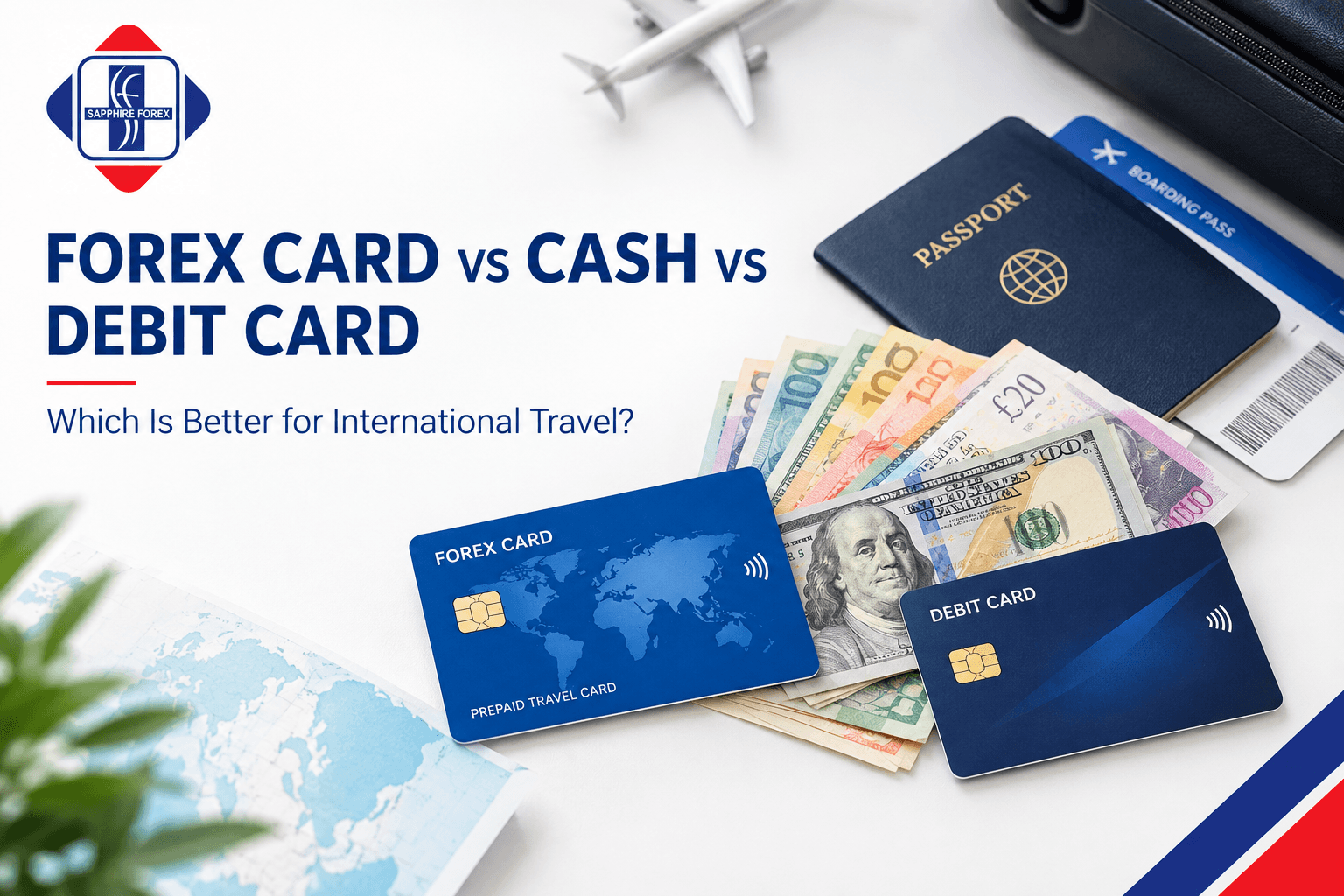
What Is a Forex Card?
A forex card is a prepaid travel card that you load with foreign currency before travelling abroad. Depending on the card, you can use it to make payments at international merchants and withdraw local currency from supported ATMs.
For example, if you are travelling to the USA, you may be able to load US dollars onto your forex card before departure.
Unlike a regular debit card, a prepaid forex card is funded separately from your bank account. This can make it easier to set a travel budget and manage your overseas spending.
Key Benefits of a Forex Card
Better budget control: Load a specific amount for your trip and monitor your spending.
Convenient payments: Pay at hotels, restaurants, shops, and other merchants that accept your card network.
Exchange-rate planning: When you load a supported currency at a quoted rate, you can know the exchange rate for that transaction in advance, subject to the provider’s terms.
Reduced dependence on cash: Avoid carrying large amounts of physical currency.
Travel-friendly features: Some cards support multiple currencies, online transaction controls, balance tracking, and emergency assistance.
What Should You Watch Out For?
Forex cards may have issuance fees, reload fees, ATM withdrawal charges, inactivity fees, or other applicable charges. Fees vary by provider and card.
You should also check what happens if you spend in a currency that is not loaded onto your card. Cross-currency conversion fees or other charges may apply.
Best for: International travellers, students studying abroad, frequent flyers, and people who want a dedicated budget for overseas expenses.
If you are considering a forex card for your next trip, explore the available foreign exchange services through Sapphire Forex and check the applicable card features, rates, and charges before making a decision.
What Is Foreign Currency Cash?
Foreign currency cash means carrying physical banknotes in the currency used at your destination.
For example, you might carry euros when visiting France, pounds when visiting the UK, or US dollars when visiting the USA.
Although digital payments are increasingly common, cash remains useful when you need to pay small vendors, use local transport, tip service staff, or visit places that do not accept cards.
Key Benefits of Foreign Currency Cash
Useful for small expenses: Pay for snacks, tips, local transport, and purchases at cash-only establishments.
No card machine required: Cash works even when a merchant does not accept digital payments.
No card transaction fee on the purchase itself: However, the exchange rate or service fee paid when obtaining the cash can affect the overall cost.
Useful during emergencies: Cash can help when your card is lost, declined, or temporarily unusable.
Easy to track physically: You can see how much cash you have left.
What Are the Disadvantages?
Carrying too much cash can expose you to loss or theft. Once lost, physical currency is generally difficult to recover.
You may also have to spend time finding a reliable currency exchange provider, comparing rates, and arranging your currency before departure.
Unused foreign currency may need to be exchanged again when you return, potentially at a different rate and with additional costs.
Best for: Small daily expenses, tips, local transport, emergencies, and destinations where cash is commonly used.
To prepare before departure, you can explore foreign currency exchange options through SapphireForex.com and compare the available rates and applicable charges.
What Is an International Debit Card?
An international debit card is linked to your bank account and may allow you to pay overseas merchants or withdraw money from international ATMs, provided international usage is enabled.
When you make a payment in a foreign currency, the transaction is generally converted into your account’s billing currency. Your bank, card network, and other applicable parties may influence the exchange rate and total cost.
For example, when you use an Indian bank debit card to pay in euros, the amount is typically converted and charged to your linked account in Indian rupees.
Key Benefits of an International Debit Card
No separate prepaid balance to arrange: You can use available funds in your linked bank account.
Convenient for unexpected expenses: It can provide access to additional funds if your travel budget changes.
Useful as a backup: A second payment card can help if your primary card is lost, blocked, or declined.
Familiar banking access: You can manage your account through your bank’s app and other available services.
Potentially useful for online payments: Depending on your card and bank settings, you may be able to pay for international bookings and purchases.
What Are the Disadvantages?
The biggest consideration is the total cost of overseas transactions.
Your bank may charge a foreign currency markup, international transaction fee, or other applicable charges. International ATM withdrawals may also attract fees from your bank and the ATM operator.
Additionally, exchange rates can vary between the time you make a transaction and the time it is processed.
Before travelling, check your bank’s fee schedule and confirm that international transactions are enabled.
Best for: Travellers who want convenient access to their bank account, need a backup payment method, or expect to make occasional overseas transactions.
Forex Card vs Cash vs International Debit Card: A Quick Comparison
Here’s how the three options compare across important travel considerations.
| Feature | Forex Card | Foreign Currency Cash | International Debit Card |
|---|---|---|---|
| How it works | Prepaid card loaded with supported foreign currency | Physical foreign banknotes | Card linked to your bank account |
| Budget control | Good; manage a separate prepaid balance | Good; limited to cash carried | Depends on account balance and spending controls |
| Exchange-rate planning | Often possible when loading currency at a quoted rate | Possible when purchasing cash at a quoted rate | Rate generally applied during transaction processing |
| Merchant payments | At supported card-accepting merchants | Wherever cash is accepted | At supported card-accepting merchants |
| ATM withdrawals | Usually supported, subject to card and ATM rules | Not required for cash already carried | Usually supported if international ATM access is enabled |
| Potential charges | Issuance, reload, ATM, conversion, or other applicable fees | Exchange-rate margin or service fee when buying or selling cash | Foreign currency markup, transaction, ATM, or other applicable fees |
| Risk if lost | Report and block the card promptly; recovery depends on the circumstances and provider | Physical cash is difficult to recover | Contact your bank to block the card |
| Best use | Planned overseas spending | Small purchases and emergencies | Backup funds and additional spending flexibility |
Note: Features, fees, exchange rates, and protections vary by provider, card network, bank, and destination. Always check the applicable terms before travelling.
Which Option Is Cheaper: Forex Card, Cash, or Debit Card?
The cheapest option is not necessarily the one with the lowest advertised exchange rate. You need to consider the total cost of accessing and spending your money abroad.
Here are three factors to compare.
1. Exchange Rate
When purchasing foreign currency cash or loading a forex card, compare the quoted rate offered by the provider.
For an international debit card, check how the bank determines its exchange rate and whether a foreign currency markup applies.
A small difference in the rate can affect the total cost of a large transaction.
2. Additional Fees
Check for:
Forex card issuance and reload charges.
Cash exchange margins or service fees.
International debit card transaction charges.
ATM withdrawal fees.
Fees for spending in a currency different from the one loaded.
Refund, cancellation, or unused-balance charges, where applicable.
Do not compare exchange rates alone. Compare the final amount you pay for the same overseas spending amount.
3. Your Spending Habits
Your payment method should match how you travel.
If you mostly pay by card, a forex card may be convenient. If you visit local markets or use cash-based transport, physical currency becomes more important. If you need flexibility for unexpected expenses, an international debit card can provide an additional source of funds.
The smartest approach is to compare the actual costs of all three options before deciding.
You can begin planning your foreign currency requirements through SapphireForex.com or explore online currency booking through EasyBuyFX.com.
Which Is Better for Different Types of Travellers?
There is no single payment method that works best for everyone. Your travel plans make a difference.
1. For International Holiday Travellers
Recommended approach: Forex card + foreign currency cash + debit card backup.
Use a forex card for eligible hotel payments, shopping, dining, and other card transactions. Carry some local currency for smaller purchases and emergencies, and keep a debit card separate as a backup.
This combination gives you flexibility without requiring you to carry your entire travel budget in cash.
2. For Students Studying Abroad
Recommended approach: A suitable forex card + cash for immediate expenses.
Students may need to pay for groceries, transport, meals, and other day-to-day expenses after arriving overseas.
A forex card can help with spending control, while cash can be useful during the first few days. Students should also check how they will access additional funds and whether their destination requires local banking arrangements.
For tuition fees, accommodation deposits, and other large transfers, check whether an international remittance service is more appropriate than a card payment.
Students and their families can explore foreign exchange and international payment services through Sapphire Forex to help plan their overseas financial requirements.
3. For Business Travellers
Recommended approach: Forex card + corporate or personal debit card backup.
Business travellers often need to pay for accommodation, meals, transport, and other work-related expenses.
A forex card can help separate travel spending from everyday banking, while a backup card provides flexibility if a transaction is declined.
Keep receipts and check your organisation’s expense-reimbursement policy.
4. For Short International Trips
Recommended approach: A payment card + a modest amount of cash.
For a short trip, you may not need to carry several payment products. Choose a suitable card based on its fees and acceptance, and keep enough local currency for essential purchases.
5. For Destinations Where Cash Is Commonly Used
Recommended approach: More local currency, supported by a card for larger purchases.
Some destinations and small businesses rely more heavily on cash. Research local payment habits before departure and carry an appropriate amount of local currency.
Avoid exchanging more money than you reasonably expect to need, particularly if exchanging it back later could involve additional costs.
How to Book Foreign Currency Online Before Your Trip
Planning your currency requirements in advance can help you avoid last-minute stress at the airport or your destination.
If you are travelling from India, you can explore the online currency booking facilities available through EasyBuyFX.com.
EasyBuyFX is Sapphire Forex’s online currency booking portal, designed to help customers book foreign currency and access supported foreign exchange services online.
Depending on the services available for your location and transaction, you can explore options for purchasing foreign currency, selling eligible leftover foreign currency, and loading or reloading a forex card.
Before placing an order, check the available currencies, applicable rates, service charges, documentation requirements, payment options, and delivery or collection arrangements.
For more information about the company’s foreign exchange services, visit SapphireForex.com.
A little preparation before departure can make managing your travel money much easier.
7 Things to Check Before Choosing Your Travel Payment Method
Before you exchange money or activate your card, use this checklist.
1. Compare the exchange rate. Check the actual rate offered for the currency you need.
2. Read the fee schedule. Look beyond the advertised rate to identify issuance, reload, conversion, and withdrawal charges.
3. Check card acceptance. Confirm that your card network and card type are supported at your destination and by the merchants you expect to use.
4. Understand ATM charges. Check both your card provider’s fees and any fees charged by the ATM operator.
5. Review international usage settings. Ensure your debit card is enabled for the intended overseas transactions, and understand any spending limits.
6. Carry a backup. Avoid depending on a single payment method. Keep your backup card and cash in a separate, secure location.
7. Protect your money. Use transaction alerts, secure your PIN, avoid sharing OTPs, and contact your provider immediately if your card goes missing.
One additional tip: when a card terminal or ATM asks whether you want to pay in Indian rupees or the local currency, choosing the local currency is often preferable. Paying in INR may involve dynamic currency conversion at a less favourable rate. Check the displayed rate and any fees before confirming.
Final Verdict: Which Is Better?
So, should you choose a forex card, foreign currency cash, or an international debit card?
The answer depends on how you plan to spend overseas.
Choose a forex card if you want a dedicated travel balance and prefer to plan your foreign currency spending in advance.
Choose foreign currency cash for small purchases, tips, local transport, and situations where cards are not accepted.
Choose an international debit card for convenient access to your bank account and as an additional source of funds.
For many travellers, combining these options is more practical than relying on just one.
A forex card can help you manage planned expenses, cash can cover smaller payments, and a debit card can serve as a backup. Compare the rates, fees, and terms before making your decision.
Planning an International Trip? Get Your Currency Ready.
Don’t leave your foreign currency arrangements until the last minute.
With Sapphire Forex, you can explore foreign exchange solutions for your international travel needs. If you prefer to plan online, visit EasyBuyFX to explore its currency booking options.
Whether you need foreign currency for a holiday, a business trip, or overseas education, make an informed choice based on your destination, spending requirements, and budget.
Explore your options today:
Foreign exchange services: www.sapphireforex.com
Online currency booking: www.easybuyfx.com
Plan ahead, compare your options, and travel with greater financial confidence.
Frequently Asked Questions (FAQs)
1. Is a forex card better than an international debit card?
A forex card can be a good choice if you want to set aside a dedicated travel budget and load foreign currency at a quoted rate before departure. An international debit card can be more convenient when you need access to your bank account. Compare their exchange rates, fees, and usage limits before choosing.
2. Should I carry cash if I have a forex card?
Yes. Carrying some foreign currency cash is advisable even if you have a forex card. Cash can be useful for tips, small purchases, local transport, and emergencies when card payments are unavailable.
3. Which is cheaper for international travel: a forex card or a debit card?
The cheaper option depends on the card’s exchange rate, foreign currency markup, ATM withdrawal fees, and other applicable charges. Compare the total cost of making the same transaction rather than relying only on the advertised exchange rate.
4. Can I withdraw cash using a forex card?
Most forex cards support ATM withdrawals, but availability depends on the card, ATM network, destination, and applicable limits. ATM operator fees and card provider charges may apply.
5. Can I use my international debit card in any country?
Not necessarily. International usage depends on your bank, card network, destination, merchant acceptance, and applicable restrictions. Before travelling, confirm that your card is enabled for international transactions and check the relevant fees and limits.
6. Is it safe to carry foreign currency cash abroad?
Carrying a reasonable amount of foreign currency cash is useful, but large amounts increase the risk of loss or theft. Keep cash secure, avoid displaying large sums in public, and use a suitable payment card for other expenses where possible.
7. What happens if I have leftover foreign currency after my trip?
You may be able to exchange eligible leftover banknotes back into Indian rupees through an authorised foreign exchange provider. Forex card balances may be eligible for refund or encashment under the issuer’s applicable terms and regulatory requirements. Check the exchange rate, fees, and documentation requirements before proceeding.
8. Should I choose INR or local currency when paying by card abroad?
When a merchant or ATM offers to convert the payment into Indian rupees, compare the displayed exchange rate and fees carefully. Paying in the local currency is often preferable because dynamic currency conversion may include an additional markup.
9. Can students use a forex card while studying abroad?
Yes, subject to the card’s eligibility requirements and terms. A forex card can help students manage everyday expenses, such as groceries, transport, and shopping. Students should also plan how to access additional funds and arrange larger payments, such as tuition fees, where necessary.
10. Where can I exchange foreign currency before travelling from India?
You can purchase foreign currency through an RBI-authorised bank or money changer, subject to applicable regulations and documentation requirements. Compare exchange rates and service charges before purchasing. You can explore foreign currency exchange options through Sapphire Forex at Sapphire Forex.