
Have you ever compared currency exchange rates at two different counters and wondered why the numbers don’t match? It can feel confusing. After all, a US Dollar has one global value—so why should two money exchange counters in the same city offer different rates?
The truth is, currency exchange works more like a competitive retail market than a fixed-price system. Just like two shops may sell the same product at different prices, forex dealers adjust their rates based on business strategy, cost, demand, and market timing.
Understanding how currency exchange works can help you avoid overpaying and make smarter financial decisions. Let’s break it down clearly so you know exactly why rate differences happen—and what you should look for before exchanging your money.
What Is Currency Exchange?
Currency exchange is the process of converting one country’s currency into another. If you are traveling abroad, sending money for education, or handling international payments, you will need foreign currency.
How Money Exchange Works
When you approach a forex counter, they are essentially buying and selling currencies. They purchase foreign currency at a “buy rate” and sell it at a “sell rate.” The difference between these two is their margin.
Banks trade currency among themselves at what is called the interbank rate. However, retail customers do not receive this exact rate. Forex companies add a markup to cover operational costs and earn profit.
Who Regulates Currency Exchange in India?
In India, currency exchange is regulated by the Reserve Bank of India (RBI). Only authorized money changers can legally provide forex services. Choosing an RBI-authorized company ensures transparency, compliance, and protection from fraud.
Understanding Exchange Rates
Interbank Rate vs Retail Rate
The interbank rate is the base rate used between financial institutions. It fluctuates every second depending on global markets.
The retail rate is what customers see at forex counters. It includes the dealer’s markup.
Buy Rate vs Sell Rate
- Buy Rate: The rate at which the dealer buys foreign currency from you.
- Sell Rate: The rate at which the dealer sells foreign currency to you.
The spread between these two rates is how money exchange businesses operate sustainably.
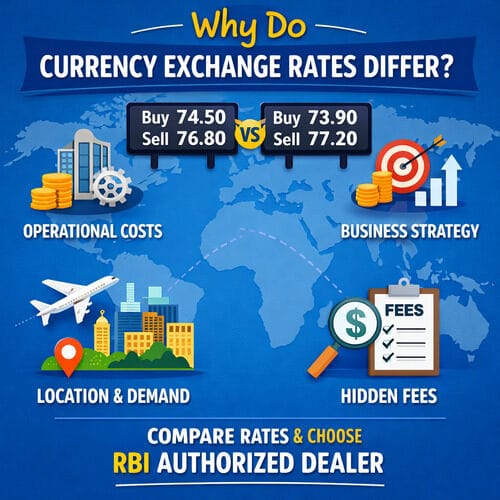
Why Two Currency Exchange Counters Offer Different Rates
1. Operational Costs Differ
Every forex business has different expenses—rent, salaries, utilities, technology systems, and compliance costs. A counter inside a premium mall or airport pays significantly higher rent than a standalone office. Higher expenses often result in slightly higher exchange rates.
2. Profit Margins and Business Strategy
Some currency exchange companies focus on high volume with smaller margins. Others prefer fewer transactions but slightly higher profits per deal. Both approaches are legitimate business models, but they create pricing differences.
3. Location-Based Pricing
Airport exchange counters often offer higher rates due to convenience pricing. Travelers in a hurry may not compare rates. In contrast, city-based forex dealers face direct competition and usually offer more competitive pricing.
4. Demand and Supply
If demand for a particular currency increases—such as during peak travel season—rates may adjust. Similarly, limited supply of certain currencies can influence pricing.
5. Transaction Size
Large transactions sometimes receive better rates. Forex dealers may provide preferential pricing to customers exchanging higher amounts.
6. Hidden Charges or Service Fees
Some counters display attractive rates but add service charges later. Others include everything within the quoted rate. Always ask for the final amount you will receive.
Airport Counters vs Local Forex Providers
Why Airport Rates Are Higher
Airports operate on convenience pricing. Customers often exchange money at the last minute. Limited competition within airport premises also affects pricing.
Benefits of Authorized Local Forex Dealers
Local RBI-authorized dealers typically provide better transparency and competitive rates. They operate in a competitive environment, which benefits customers.
For example, Sapphire Forex, an RBI authorized money exchange company, provides regulated and transparent currency exchange solutions. Customers looking for reliable and compliant transactions can explore sapphire forex services for secure forex assistance.
The Importance of Choosing the Right Forex Partner
Exchanging currency is not just about finding the lowest rate. Trust, authenticity, and compliance matter just as much.
Unauthorized dealers may offer tempting rates, but risks include counterfeit currency, lack of documentation, and legal issues. Choosing an RBI-authorized company ensures:
- Genuine currency notes
- Proper billing and compliance
- Transparent pricing
- Legal security
If you want clarity about current exchange rates and compliance-backed transactions, you can contact sapphire forex for professional guidance and reliable service.
Why Exchange Rates Fluctuate Daily
Exchange rates are influenced by global economic conditions such as:
- Inflation
- Interest rate changes
- Political developments
- Trade balances
- International market movements
Even within the same day, rates may shift slightly. Different forex counters may update their pricing at different intervals, which can also cause minor variations.
How to Get the Best Currency Exchange Rate
- Compare rates from multiple RBI-authorized dealers.
- Ask for the final receivable amount after all charges.
- Avoid last-minute airport exchanges when possible.
- Exchange larger amounts in one transaction if feasible.
- Always verify authorization before proceeding.
Being informed helps you save money and avoid unnecessary stress.
Conclusion
Two currency exchange counters in India offering different rates is completely normal. The variation happens because of operating costs, profit strategies, location factors, demand-supply conditions, and service models.
Currency exchange is a competitive business, not a fixed-rate system. The smartest approach is to compare rates, ensure RBI authorization, and focus on transparency. When you understand the reasoning behind rate differences, you make confident financial decisions instead of second-guessing yourself.