
Understanding Currency Exchange Rates
What Are Exchange Rates and How Do They Work?
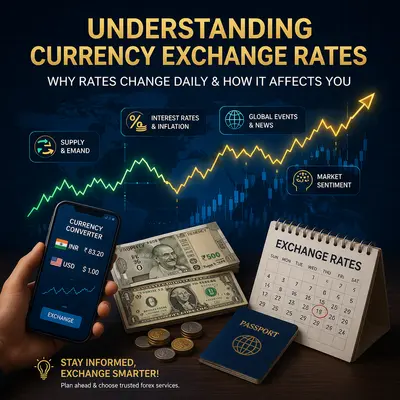
Currency exchange rates represent the value of one country’s currency compared to another. In simple terms, it tells you how much of one currency is needed to purchase another. For example, how many Indian Rupees (INR) you need to buy one US Dollar (USD). These rates are not fixed—they constantly change due to global economic activity.
Think of exchange rates as a live marketplace where currencies are traded continuously. When demand for a currency increases, its value rises. When demand decreases, its value falls. This is especially important in the context of currency exchange in India, where individuals and businesses frequently deal with foreign currencies.
With over $7 trillion traded daily in the global forex market, even minor events can influence exchange rates. Understanding this helps you make informed financial decisions instead of exchanging currency blindly.
Fixed vs Floating Exchange Rate Systems
Currencies operate under either fixed or floating systems. In a fixed system, a country pegs its currency to another major currency, ensuring stability. In a floating system, exchange rates are determined by market demand and supply.
India follows a managed floating system, where the Reserve Bank of India occasionally intervenes to stabilize extreme fluctuations. This is why exchange rates in India change daily, creating both risks and opportunities.
The Core Factors That Influence Daily Currency Fluctuations
Supply and Demand in the Forex Market
Supply and demand are the primary forces driving currency value. When demand for a currency rises, its value increases. When demand drops, its value decreases. For example, when foreign investors invest in India, they need INR, increasing demand and strengthening the rupee.
Trade also plays a significant role. Higher exports increase demand for INR, while higher imports increase demand for foreign currencies. Tourism and remittances also contribute to currency movement.
Inflation, Interest Rates, and Economic Stability
Inflation impacts purchasing power. Countries with lower inflation tend to have stronger currencies because their money retains value. Interest rates also influence currency strength—higher rates attract investors, increasing demand.
Political and economic stability further boost investor confidence. Stable economies attract foreign investments, strengthening their currencies, while uncertainty can lead to depreciation.
Why Currency Exchange Rates Change Every Day
Continuous Global Trading
The forex market operates 24 hours a day across global financial centers. This continuous activity ensures that exchange rates are always changing based on real-time demand and supply.
Speculation and Market Sentiment
Investor perception plays a major role in currency value. Traders react to news, economic data, and global events. If investors expect a currency to strengthen, they start buying it, increasing its value even before actual changes occur.
How Currency Fluctuations Impact You
Travelers and Students
Exchange rates directly impact travel and education costs abroad. A slight increase in currency value can significantly raise expenses, especially for long-term stays like studying overseas.
Businesses and Trade
Importers and exporters are heavily affected by currency fluctuations. A weaker rupee benefits exporters but increases costs for importers. Businesses often plan transactions strategically to manage these risks.
How You Can Benefit from Currency Fluctuations
Time Your Exchange Smartly
Timing plays a crucial role in currency exchange. Monitoring trends and avoiding last-minute exchanges can help you secure better rates. Splitting transactions over time can also reduce risk.
Choose the Right Forex Partner
Working with a reliable provider ensures better rates and transparency. An RBI-authorised company like Sapphire Forex offers trusted solutions for individuals and businesses.
With professional sapphire forex services, you gain access to competitive pricing and expert support. For personalized assistance, you can always contact sapphire forex to make smarter currency exchange decisions.
Common Mistakes to Avoid
Many people exchange currency at airports or wait until the last moment, leading to poor rates. Another mistake is not comparing providers. Even small differences in rates can result in significant losses.
Future Trends in Currency Exchange
Digital platforms and real-time analytics are transforming the forex industry. Currency exchange is becoming more transparent and accessible, especially in India’s growing global economy.
Conclusion
Currency exchange rates fluctuate daily due to factors like demand, interest rates, global events, and investor behavior. Understanding these factors helps you make smarter financial decisions.
By planning ahead and working with trusted partners like Sapphire Forex, you can turn currency fluctuations into opportunities instead of risks.