
The answer lies in how forex pricing works. Currency exchange is influenced by global market movements, business strategies, operational costs, demand and supply, and regulatory compliance. Understanding these factors helps you make smarter decisions when exchanging money.
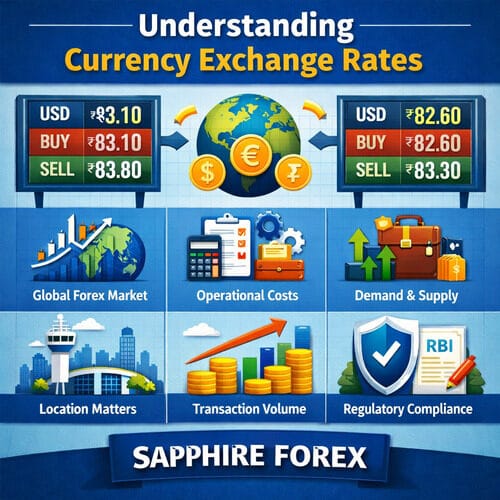
Understanding How Currency Exchange Rates Are Determined
Currency exchange rates are primarily influenced by the global forex market where banks trade currencies with each other. This rate is known as the interbank rate. However, customers do not receive this exact rate at retail counters.
Exchange counters apply a margin to cover:
- Operational costs
- Market risk
- Regulatory compliance expenses
- Business profit
Each forex provider decides its own margin structure. That’s why two counters rarely display identical rates.
Interbank Rate vs Retail Rate
The interbank rate is the price at which major banks trade currencies. Retail customers receive a retail rate, which includes a spread.
What Is a Spread?
The spread is the difference between the buying rate and selling rate. This spread varies between forex dealers based on their pricing strategy.
Established providers like Sapphire Forex aim to maintain competitive spreads while ensuring transparency and compliance.
Location Plays a Major Role
Airport Exchange Counters
Airport counters often provide less competitive rates because:
- High rental costs
- Limited competition
- Urgent customer demand
- Convenience pricing
City-Based Counters
Forex counters located in commercial areas face higher competition. Increased competition often leads to better pricing for customers.
Demand and Supply Factors
Currency value at retail level is influenced by demand and supply.
For example:
- Holiday seasons increase demand for USD and EUR
- Student visa periods raise foreign currency demand
- Business travel affects currency availability
If a counter has limited stock of a currency, they may increase the selling price. Another counter with surplus stock may offer better rates.
Operational Cost Differences
Not all exchange counters operate with the same expenses. Costs may include:
- Office rent and utilities
- Employee salaries
- Security arrangements
- Technology systems
- RBI licensing fees
Companies like Sapphire Forex invest in secure systems and regulatory compliance to ensure customer safety and service quality.
Transaction Volume Impact
High-volume forex providers can offer tighter margins because they earn profit through transaction volume. Smaller counters may charge slightly higher margins to remain profitable.
Major vs Exotic Currencies
Major currencies such as USD, EUR, and GBP usually have tighter spreads due to high global demand.
Exotic currencies may have wider spreads due to lower liquidity and higher risk.
Real-Time Rate Updates
Forex markets fluctuate constantly. Some counters update rates in real time using automated systems, while others update manually at intervals. Timing differences can create visible rate variations.
Hidden Charges and Transparency
Sometimes the difference isn’t in the rate itself but in additional charges such as:
- Service fees
- Processing charges
- Commission
Always confirm whether the quoted rate is final and inclusive of all charges.
Negotiation Opportunities
Exchange rates can sometimes be negotiated, especially for large transactions. If you are exchanging a significant amount, you may receive a better customized rate.
For competitive pricing and professional assistance, you can contact sapphire forex to explore personalized forex solutions.
Online Booking vs Walk-In Rates
Online forex booking platforms often offer better rates due to lower operational overhead. Booking online may allow you to lock in a favorable rate before visiting the branch.
Regulatory Compliance Requirements
In India, forex operations are regulated by the Reserve Bank of India (RBI). Authorized dealers must follow strict compliance measures including:
- KYC documentation
- Anti-money laundering checks
- Transaction reporting
These compliance measures ensure customer safety and legal transparency.
Business Strategy Differences
Some forex providers compete aggressively on price, while others focus on premium service, reliability, and customer experience. This difference in business strategy also affects rate structures.
Tips to Get the Best Currency Exchange Rate
- Compare rates from multiple authorized dealers.
- Avoid airport exchanges when possible.
- Exchange larger amounts in a single transaction.
- Ask about additional fees.
- Choose RBI-authorized providers.
Conclusion
Two currency exchange counters in India offer different rates due to operational costs, location, demand and supply, transaction volume, compliance expenses, and business strategies. There is no single fixed retail rate — each dealer applies its own pricing model.
To ensure transparency, competitive rates, and secure transactions, consider choosing trusted and authorized providers like Sapphire Forex for your currency exchange needs.